10 Proven Strategies for Workplace Well-Being [Guide 2025].
April 2, 2025
-
4
MIN

In concrete terms, what is global warming? Quite simply, it’s the phenomenon of rising temperatures that has been occurring on Earth for the past 100 to 150 years. The more the years go by, the more we talk about it and, above all, the more we feel its consequences:
Today, 97% of scientists working on this subject believe that the Earth is warming due to human activities. But what are they?
Let’s start by explaining what fossil fuels are. There are three types: coal, oil and gas. Formed by the decomposition of carbon-based organisms buried for millions of years, they create carbon-rich deposits that are extracted and burned to produce energy. This is how “fossil” energy is obtained!
They currently provide around 80% of the world’s energy and are also used to manufacture plastics, steel and a wide range of other products. Small hitch:
they are non-renewable. When fossil fuels are burned, they release large quantities of carbon dioxide, a greenhouse gas, into the air. Greenhouse gases trap heat in our atmosphere, fatally warming the planet.
Deforestation is the loss of forest area. Deforestation can be caused by a number of factors, including forest fires, tree diseases and pests. However, it is human activity that is largely responsible for deforestation worldwide, and therefore indirectly for global warming.
In addition to its direct impact on forest biodiversity and soil, deforestation also has a major impact on climate change. Trees store CO2 throughout their lives. By destroying these trees, we reduce the global ecosystem’s capacity to store CO2. Fewer trees means less CO2 absorbed, and therefore a greater greenhouse effect.
Since 1960, meat consumption worldwide has multiplied by 4, while the population has “only” doubled. As you can see, the omnipresence of animal products in the modern diet of developed countries has numerous ecological consequences.
Livestock production (cattle, pigs, sheep, poultry, etc.) requires large quantities of agricultural resources, creating unprecedented pressure on ecosystems. The agricultural land required for livestock production is expanding, posing a threat not only to biodiversity but also to the climate.
Replacing natural areas such as forests or wild meadows with cultivated land considerably reduces carbon sinks. Not only does this reduce the number of trees and wild plants in favor of crops, which store far less carbon, it also significantly reduces the soil’s capacity to absorb atmospheric carbon.
Now that we’ve made the diagnosis, it’s time to act! If you had a shadow of a doubt, now you know for sure: human activity is largely responsible for the global warming we are witnessing today. And it’s not just us saying it!
In its fifth assessment report, the Intergovernmental Panel on Climate Change (IPCC) acknowledged the existence of climate change, and that it was the result of human activity.
So if we’re responsible for it, we can certainly change the trend! Before you become a climate superhero, there’s one thing you can be sure of:
ALL actions are polluting because they require energy. The aim is to reduce our carbon footprint and act for a sustainable future.
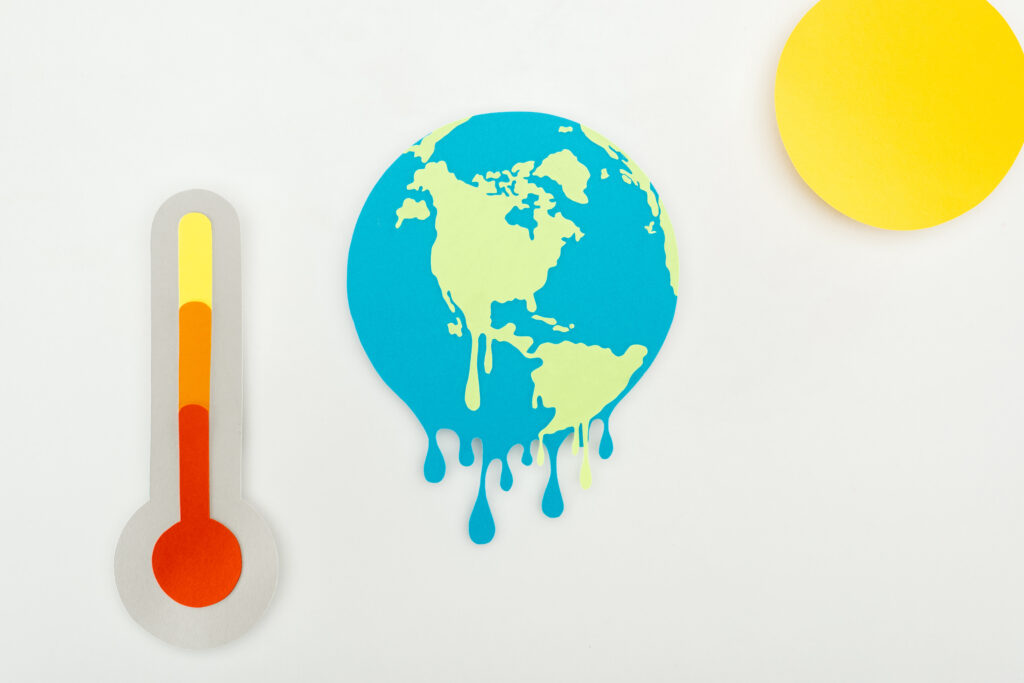
Human activities have caused global greenhouse gas emissions to soar, leading to dangerous climate disruption. To limit global warming, we need to halve our greenhouse gas emissions by 2030. There are several ways in which we can keep global warming below 2°C:
Reducing greenhouse gas emissions is known as mitigation. However, although they are essential, they are not the only possible actions for limiting the impact of global warming. There are also public adaptation policies. These aim to anticipate the expected impacts of climate change, limit the damage they may cause by acting on the factors that control their scale (e.g. urbanization in high-risk areas) and take advantage of potential opportunities. These actions are carried out on a national scale. France is one of the most advanced countries in climate change adaptation planning, with its plan published in mid-December 2018.
The third pillar in limiting the impact of global warming is to educate future generations for a sustainable future. Indeed, education is essential to promote climate action. It helps people to understand the effects of the climate crisis and to fight against them. How do we do this? By giving them the right tools: knowledge, skills, values and attitudes.
All essential ingredients for becoming tomorrow’s agents of change today. From the first grade to the final year of high school, environmental issues are at the heart of our teaching.
As you can see, all public and private players have a role to play in the fight against climate change: individuals, teachers, companies and governments alike! There are a number of ways of doing this, including regulatory measures such as greenhouse gas (GHG) emissions assessments, regional planning, extra-financial reporting by companies and investors – and voluntary commitments. How does it work in practice?
Companies have a key role to play in linking all these players! Indeed, even if they don’t all have the same carbon footprint, they all have a duty to meet the 2050 carbon neutrality targets set by the signatories to the Paris Agreement. That’s why it’s crucial that companies also take up the environmental challenge. Whether it’s out of a sense of civic duty, or to meet the demands of their customers, investors or purely legal requirements.
Indeed, since 2012, the French regulator has required companies with more than 500 employees to publish a greenhouse gas emissions balance sheet (BEGES réglementaire). In addition, since 2015, Article 173-VI of the French Energy Transition Law for Green Growth (TECV) has required investors to publish the carbon footprint of their portfolios.
Through their decisions, investment companies send out a signal to businesses, helping to steer the economy towards less carbon-intensive activities. What’s more, the benefits associated with carbon footprint assessment are not limited to the investment decision itself.
They are essential to the deployment ofengagement strategies by the most committed investors, who seek to promote good practice within their investment portfolios and encourage companies to reduce their CO₂ emissions.
According to a recent barometer, 75% of employees in large companies feel uneasy about their company’s inaction in combating the environmental crisis and growing inequalities. Six out of ten employees are even considering leaving their company for these reasons. Fortunately, some companies have heeded their call! Here are a few examples of the best initiatives:
It’s clear that major changes are in store for businesses. The good news is that OuiLive has the ultimate solution for raising your teams’ awareness of the fight against global warming. Use gamification to get your message across, and encourage as many people as possible to take action!
Why not get your employees involved in a connected challenge to raise awareness and take action? Contact us here